A story about scope
Everyone loved it. Nobody could act on the real problem.
What started as a discovery call for one small app turned into a map of five products and a much bigger idea about where things could go. The vision landed — it's the standard now. The problem underneath it was real too, and bigger than any one project could carry.
The ask
February 2026. My bosses wanted to talk about a shift lead app.
It didn't exist yet — no legacy code, no existing users, no screens to inherit. Just a blank page, which almost never happens on an enterprise team. Most of what I'd worked on at Chick-fil-A up to that point was inherited: applications built fast, by a dev team under real pressure, and handed to us afterward to make good.
So I came into that first call ready to listen rather than solve. They walked me through what they were picturing — a tool for shift leads, sitting alongside the apps the restaurants already used. Reasonable ask. Clear enough problem.
Three weeks until it went in front of stakeholders. So, no pressure.
What I actually heard
I mostly listened. Asked questions, recorded the call, wrote everything down.
They kept circling a phrase — holistic excellence, sometimes the excellence loop. They'd say it, move on, and come back to it a few minutes later. Nobody defined it, and I don't think they needed to. It was the thing they were reaching for.
Because here's what kept happening. They were describing a shift lead app. But every time they explained why they wanted one, they ended up describing how the five products they already owned might finally work together. That part wasn't in the brief anywhere. It was just in how they talked about it.
So before I drew a single screen, I went and mapped what they already had.
Six platforms, four stages, one gap
Ops Hub Shift is the piece nobody had built
They already had a name for it. What they didn't have was a picture.
Drawing the excellence loop
The only way to draw it was to follow one complaint all the way through.
So I picked something small and real — a team member flags overcooked fries — and traced every place it has to travel before anything actually changes. Five products, each owned by a different group, each doing its part correctly.
Appeals matter more than they might sound. Scores and bonuses are tied to how a restaurant is performing, so a single finding has real money attached to it. That's the pressure holding the whole loop together.
But the moment someone actually has to fix something, the work leaves the product. Email, Slack, a group text — whatever the operator uses that day. The shift lead app wasn't a new product. It was the missing piece of a loop that was falling out of the system every single time.
Drawing it also surfaced something nobody had asked me to look at. Five products doing one job, with the handoffs between them undefined, is not a shift lead problem. It's an argument for consolidating what already exists.
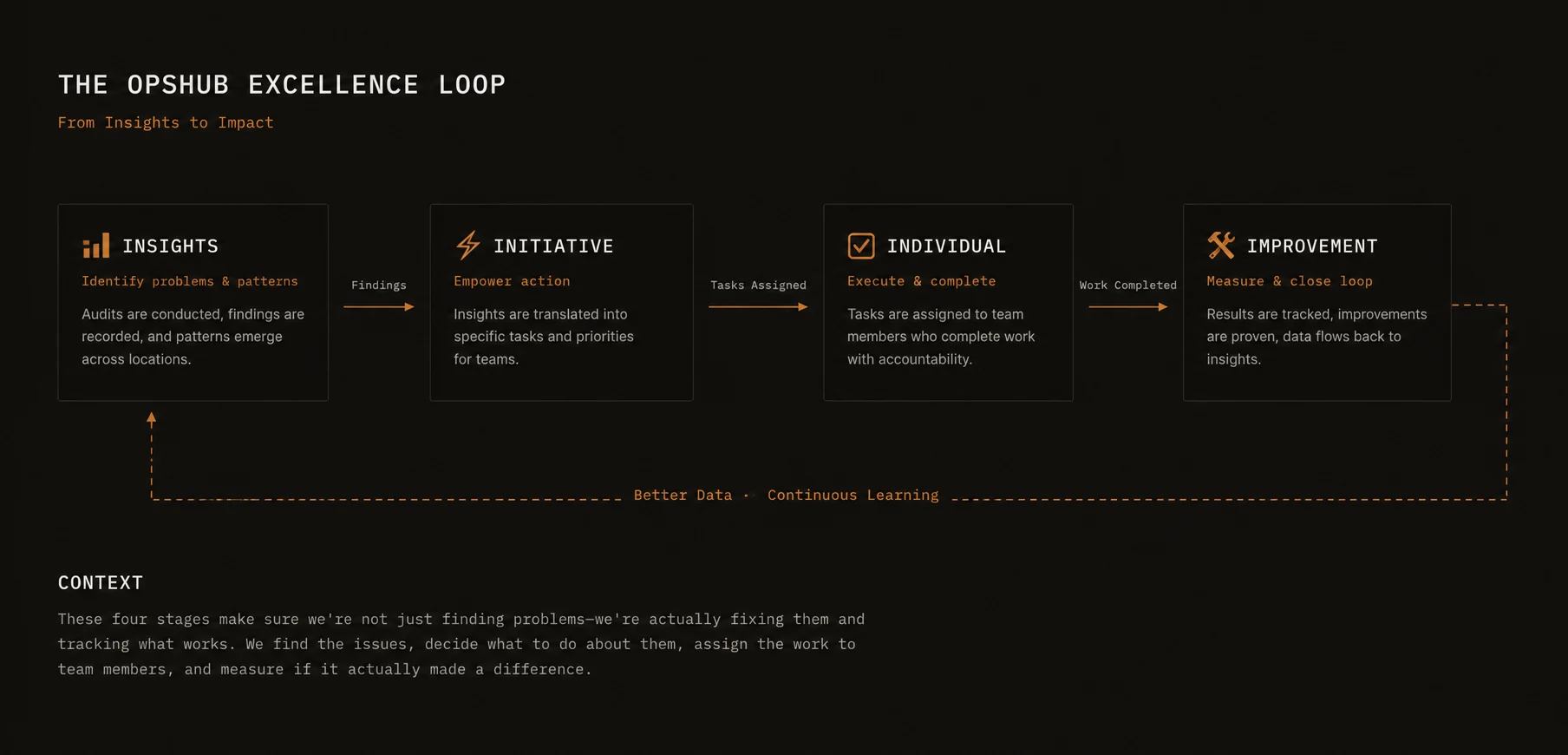
The excellence loop, from insights to impact
Taking it back to them
Nobody asked me to present findings. I asked for the time anyway.
I walked them through the loop first — the whole thing, one complaint travelling end to end, including the part where it drops out of the system. Then I showed what I thought we could do about it: five products collapsed into three. One for operators, one for headquarters, one for content.
The consolidation mattered less than the reasoning behind it, so I spent most of the time on the why. Which products were really doing the same job. Where a handoff was costing more than the feature it connected. What we'd gain by treating it as one system instead of five that happened to share a name.
That conversation is what changed the size of the project. It stopped being a shift lead app and became a 2030 vision — not because I pitched it that way, but because once the map was on the screen, the bigger version was the obvious one.
Six apps, three platforms
Grouped by who actually uses them
Designing with everyone watching
Three weeks. Calls every single day. No going away for a week and coming back with something polished.
I refined wireframes live, on the call, while stakeholders watched. It's faster than it sounds — decisions that normally take three rounds of email happen in about four minutes. But you have to be genuinely fine with people seeing rough work.
This is also where I worked out my Claude workflow, which meant Claude and Claude got to work. Two of us, one deadline, and only one of us needed sleep.
Some of these concepts had no precedent I could point at, so I'd describe the problem and get something on screen worth reacting to. Not the answer — a first draft I could argue with. A rough draft beats a blank canvas every time, because ideas come from other ideas.
Along the way I pulled in the Chick-fil-A style guide, and extended it where it had gone stale. New table patterns, a side nav, an actual portal feel. Those additions went through design system approval.
- Week 1
- Ecosystem mapped, concept presented, brief expanded
- Week 2
- Wireframes daily, style guide extended
- Week 3
- ~10 screens, animated, clickable, shipped to stakeholders
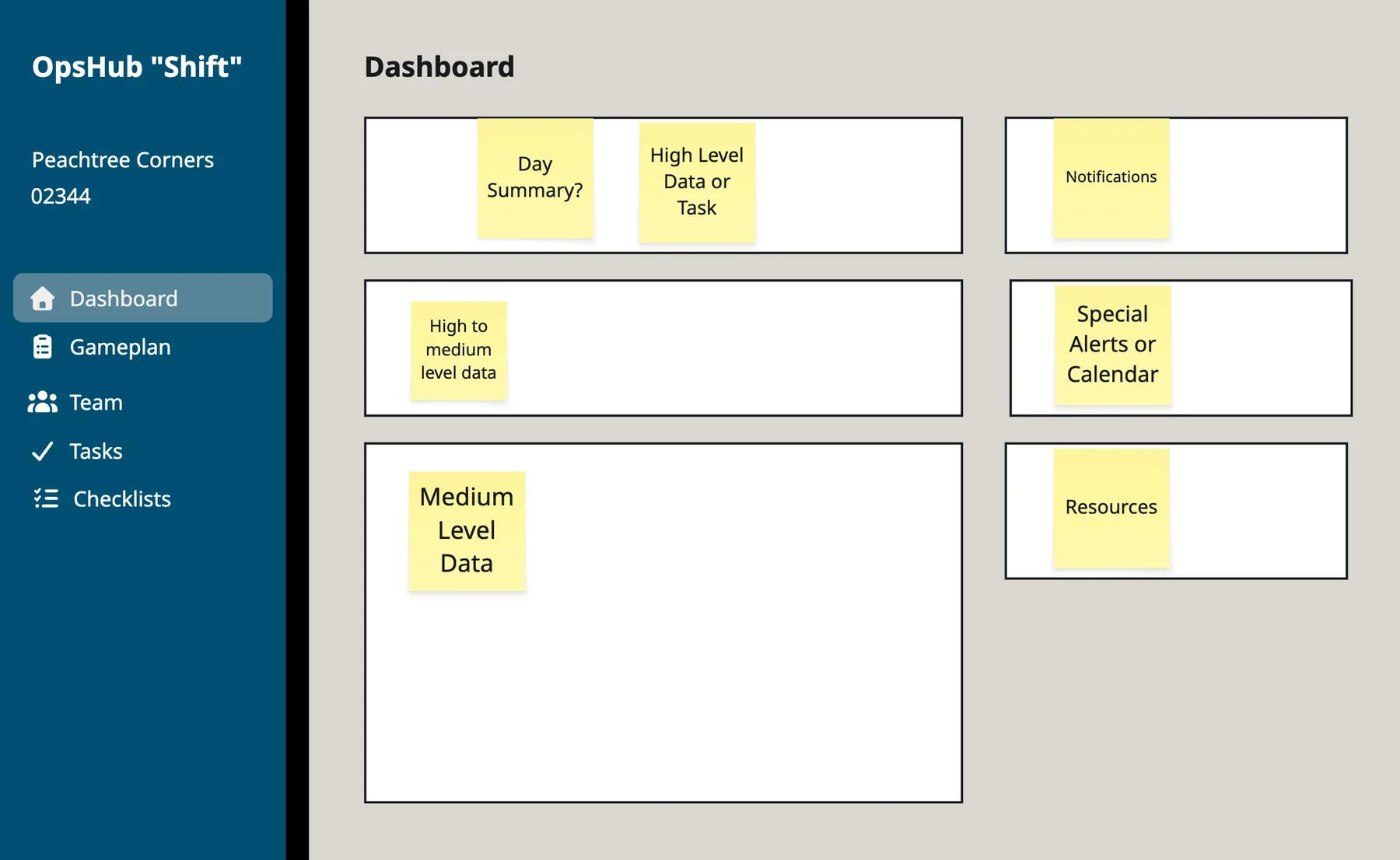
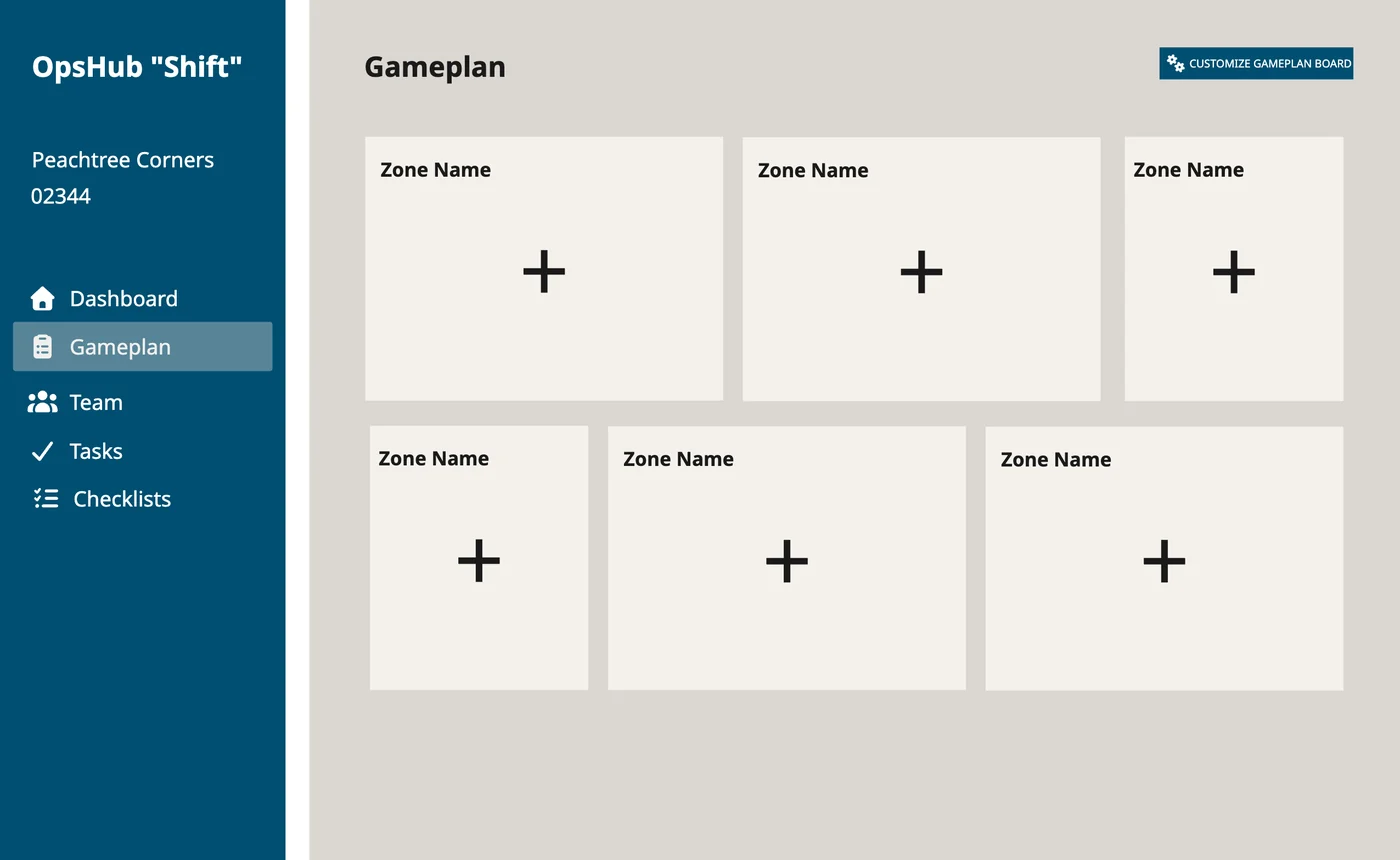
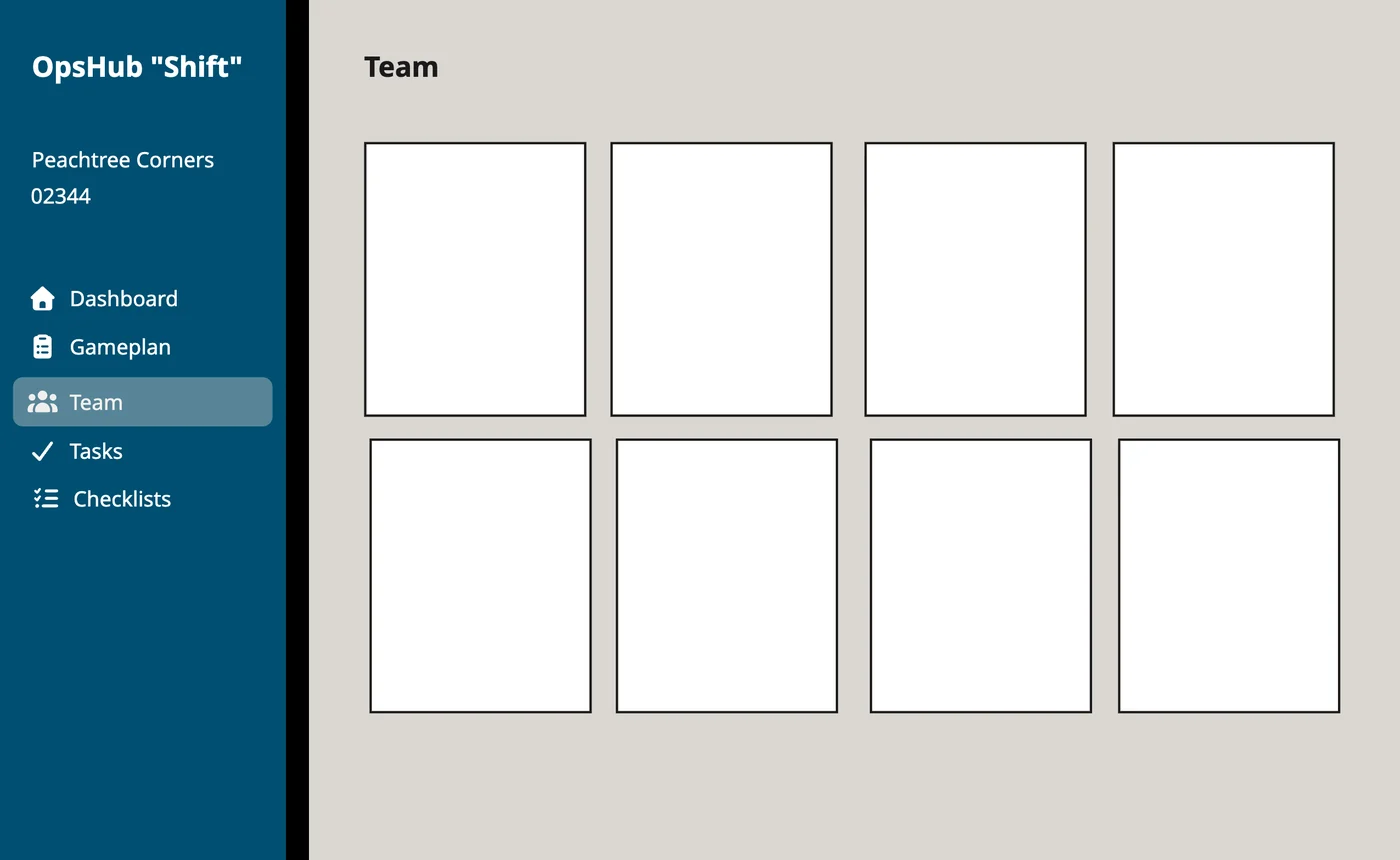
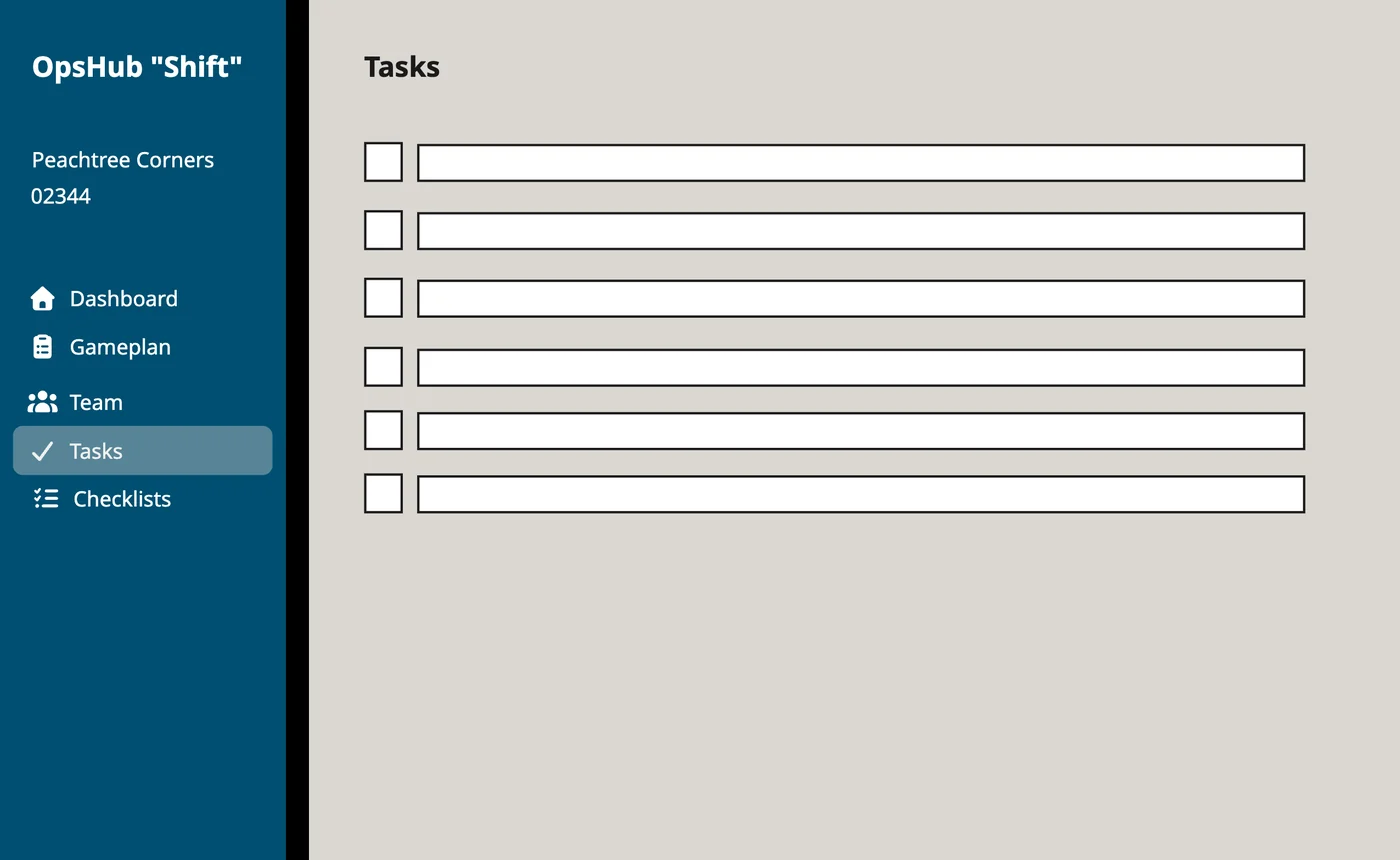
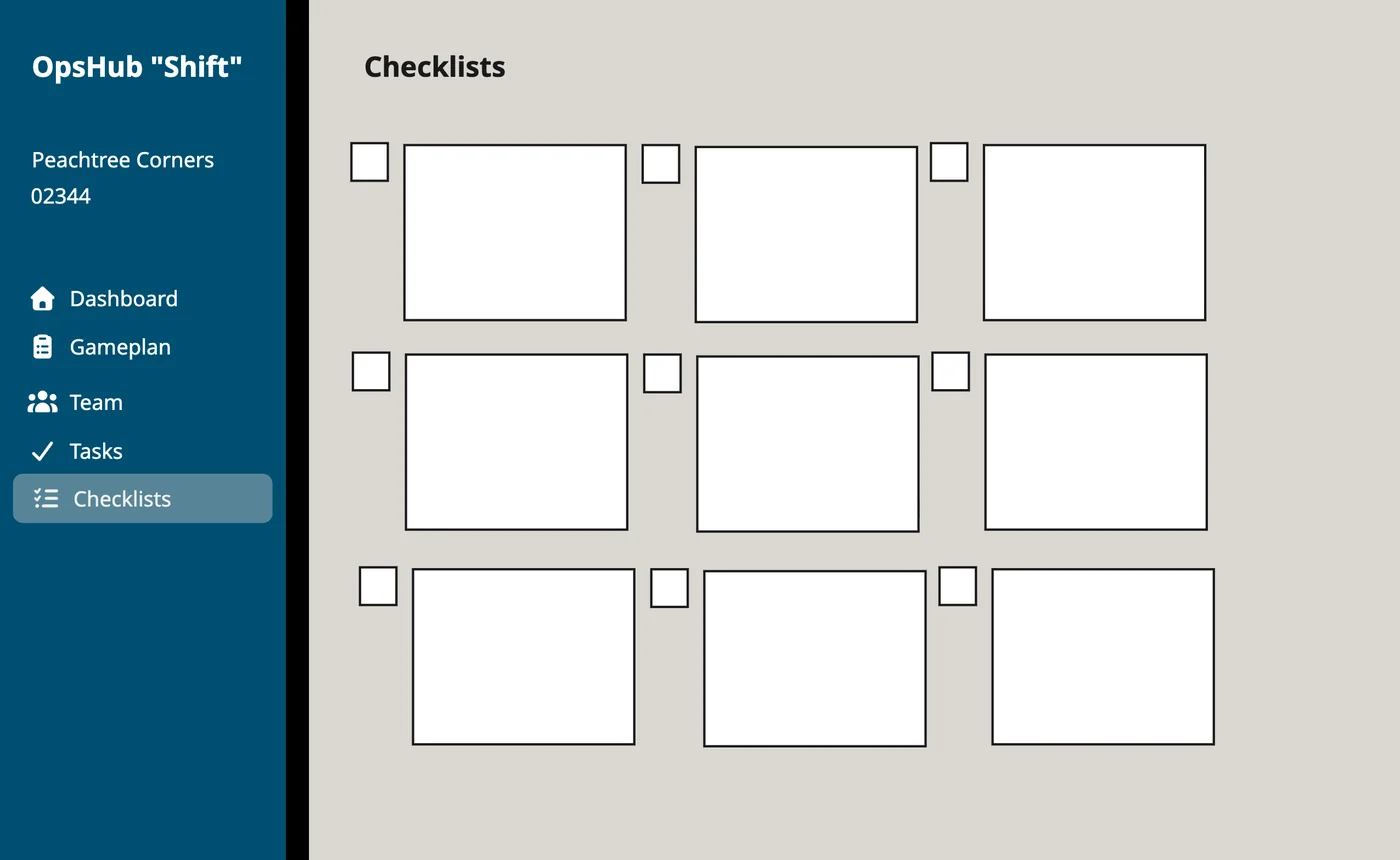
Wireframed live on the call — Miro, sticky notes, decisions made in the room
Two teams asked to meet
Partway in, two teams I hadn't met yet reached out.
They'd heard what we were working on and wanted to understand where it left their product. That's a completely reasonable thing to want to know, and I said so. The part that surprised me was that they were new to me — and, as far as I could tell, new to the people I reported to as well.
I didn't try to talk them out of the concern, because the concern was legitimate. There was real overlap. So mostly I listened, asked what their product did well, and told them plainly where I actually sat: I wasn't setting scope, I was designing against a brief, and I'd rather they heard that from me than pieced it together later.
What I couldn't offer was reassurance, because that wasn't mine to give. Those decisions were happening well above me. So I held the tension instead of resolving it, kept them in the loop as things developed, and got back to work.
I asked for one more meeting
Those two calls left me with a question I couldn't answer from where I was sitting.
If two teams I'd never met were worried about overlap, were there others? And was anyone already having the consolidation conversation at a level above all of us?
So I asked Chick-fil-A's head of UX for time. He isn't in my reporting line — I'm a contractor, so I report into my own team and the project leads, not into their design org. That's why we hadn't crossed paths three weeks into a project like this one.
The turn
There were over a hundred apps available to operators.
Some of them built by the operators themselves.
Operators run their restaurants as independent business owners, so a few of them had simply gone and built what they needed. Which, honestly, is hard to argue with.
That call reframed the whole project for me.
The problem in front of me was never the shift lead app, and it wasn't really the five products around it either. It was that there were a hundred-odd tools in operators' hands and no shared answer to what any one of them was for.
My idea got small very quickly. I'd spent three weeks making the case that five products should be three. The honest question was why there were a hundred and one.
It also explained the research budget, or the absence of one. You can't research your way to the right shift lead app when nobody has settled which problems are worth an app in the first place. Where would you even start.
And none of that was mine to solve. Nobody asked me to fix the ecosystem — they asked me to deliver the 2030 vision, and I wasn't senior enough, or internal enough, to move that conversation up the chain.
So I said it out loud, wrote it down, and shipped what was asked. Knowing which fight you can win this quarter is its own skill. So is not pretending you didn't notice.
The honest part
Once I can see the better product, I have a hard time letting it go.
I don't think that's a bad instinct. It's most of why the project got bigger in the first place, and it's why I'll always push for the version that actually solves the thing. But it does mean I've had to learn the difference between advocating for the right product and refusing to accept the one we're building today.
I'm still working on that one.
What happened
Three weeks in, the prototype was finished and my bosses took it to the room.
Stakeholders responded well. Then it went further up, and the executives responded well too — which is the part I didn't expect, because I'd built it to answer a question about shift leads, not to set direction for anything.
The 2030 prototype became the standard. Every new internal application at Chick-fil-A is now expected to move toward that design language and that structure.
And a new internal team was formed to take it further — to use those designs as the basis for one application that consolidates the hundred-plus tools operators are working with today.
Which is a genuinely good outcome, and I'm proud of it. It also created a problem I keep thinking about.
Prototype walkthrough
The prototype that became the standard — ten screens, animated, clickable
3
Weeks from brief to a clickable, animated prototype
2030
Every new internal app now moves toward this design
1
New team formed to build the consolidated application
After the credits
If this were mine to lead
The project is done and I'm glad it landed. But a new team is now building one app to replace a hundred, and I'd want them to start somewhere different than we did. This part is me thinking out loud about a job that isn't mine.
-
01
Find out who actually uses this
We don't have accurate personas for the people these tools are for. That's the gap sitting under everything else. We don't know why operators aren't using what we built for them — and until we do, every decision after this one is a guess wearing a nicer outfit.
-
02
Fund the research properly
Interview operators. Look at what they're using instead of ours and ask why. Our real advantage is the data — even when an operator builds their own tool, we can see the picture across every other restaurant, and they can't. That's a genuine reason to choose our app over theirs. It only works if ours is better, and we'd have to go earn that.
-
03
Make the case in budget terms
Here's an assumption I'd want to test: I'd bet a hundred apps are doing about five to ten overlapping jobs. The teams I met with were building something slightly different from something that already existed — that's how you get to a hundred. Maintaining all of it costs real money, and that's the language this argument needs to be made in. I'd want to protect those teams wherever we can. But the operators come first.
-
04
Then redesign — in that order
Only after all of that, start the rebuild. Built on what we learned rather than what we assumed. It's a slower start and a much shorter road.
And one thing I actually pitched
You can't hope people into caring. You have to make it worth their while.
On a few calls I heard versions of "we want to incentivize our operators to do this" — said with real heart, and no mechanism behind it. Ten years in ministry taught me that good intentions don't move people. Incentives do.
Chick-fil-A already flies operators and their families out for an event every year. So I proposed an incentive program tied to the excellence loop — not a new financial commitment so much as pointing an existing one at something specific.
Give operators a reason to take the results seriously, and the app has a reason to exist.